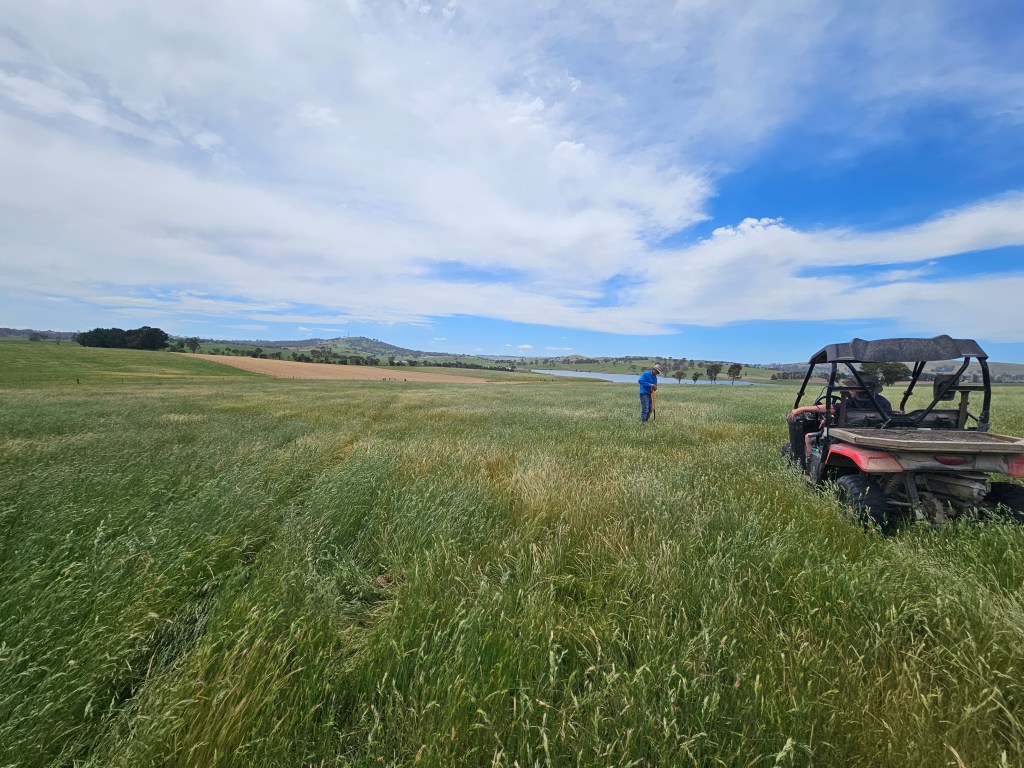
Last year we received funding from the Biodiversity Conservation Trust to run a project looking at soil microbiology across our region. As lead of that project for Mid Lachlan Landcare, I chose to trial the Microbiometer, an in-paddock soil microbiology test that allows farmers and land managers to measure their total soil microbes and the soil fungi:bacteria ratio both quickly and cost effectively. While that project finished up in August 2024, I still had test strips remaining which, during the course of this year I’ve used while going about my general farm site visits & school excursious. By late November, with around 10 test strips left I headed out with Grazing Group leader Scott Hickman to a farm in Carcoar and to a farmer who’se been doing quite a bit of experimenting of his own in the soil biology space…
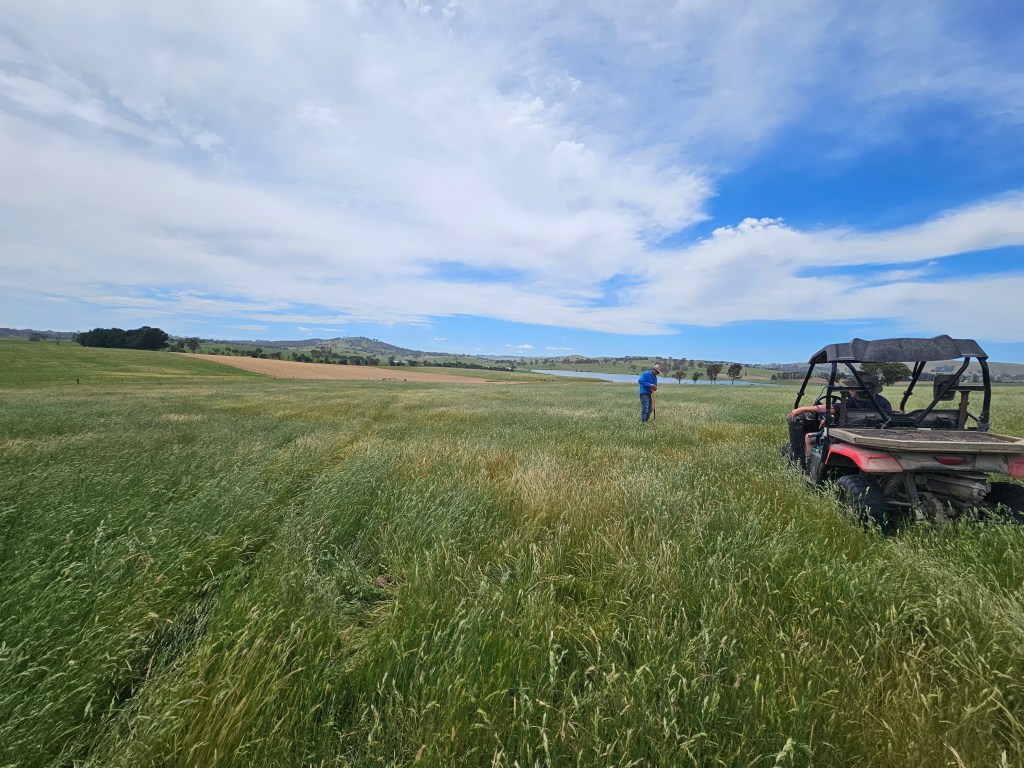
Sam has been on this farm since 1983 and has been taking a soil-biology first approach since 1991. Prioritising soil biology has taken many forms including how livestock are managed, what crops are sown, how paddocks are treated & what & when any adjuvants are added. A common narrative that exists around farmers is that they are a conservative, risk-averse bunch who tend to stick to their own tried-and-tested ways of doing things. While that can be true and, given the mental, physical and even spiritual costs associated with getting things wrong in farm-world, understandable, I’d say most farmers I meet are deeply curious, experimental & up for a challenge. You could definitely say that about Sam.
I won’t share the soil microbiology results we collected here as I’ve not yet had a chance to discuss them with Sam but suffice to say his microbes seem happy and in good balance. What I will do though is explain a little more about what we did, just in case you were wanting to do the same at your place.
Soil Microbiology & General Health Check List.
- Stick a fork in it.

One of the cheapest, fastest and most rewarding things you can do with soil is prod it! Just noticing how easy it is to get a fork in the ground tells you so much about compaction layering & soil composition.
2. Count the critters you can see.
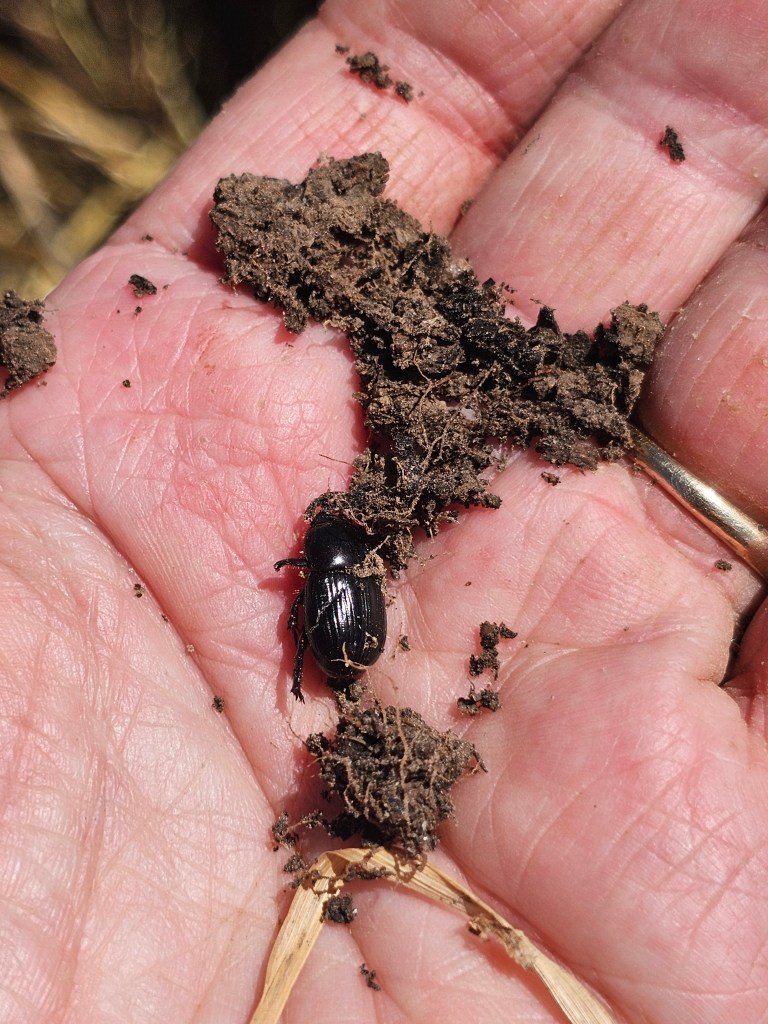
I always conduct an informal count & characterisation of what we find in a clod of soil. Soil macrofauna includes worms, beetles, ants, termites and grubs. These play a vital role in cycling nutrients – the general rule-of-thumb being ‘the more (diversity & total number) the merrier’!
3. Soil structure
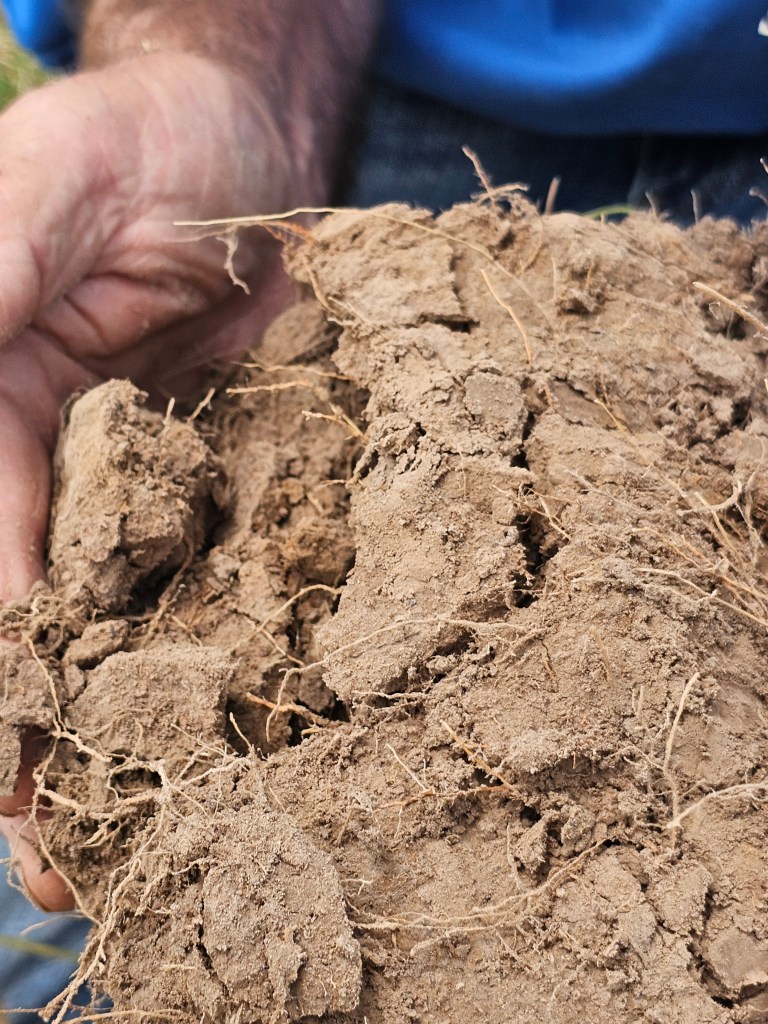
We note the colour & smell of the soil (you can smell life in the soil & get an idea if you’ve got a more bacteria or fungi dominant sample). Get a feel for soil texture (sant, silt, organic matter, clay & sand) & evaluate soil compaction.
4. Root depth & soil aggregates around plant roots

We have a look at how deep roots penetrate, how the soil adheres and aggregates around plant roots, whether the soil contains pores and other air spaces, how well it holds together & how heavy it feels.
5. Biodiversity.
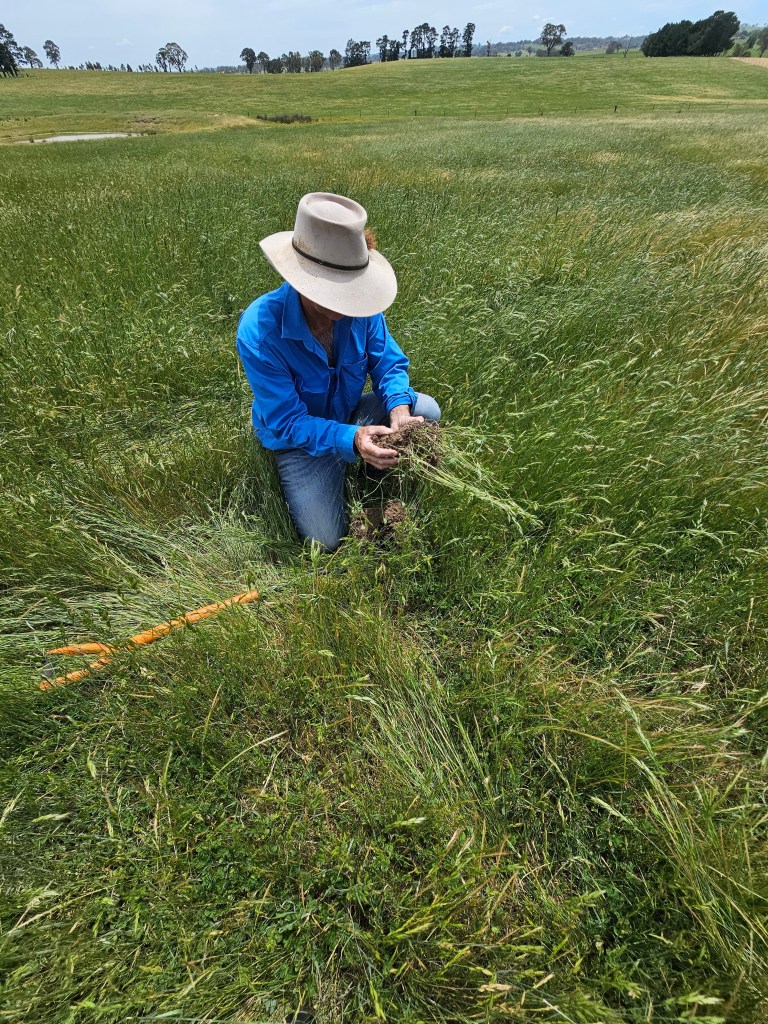
We look at what species are growing, the variety of species and the condition of the paddocks – bare ground vs green growth vs brown material.
6. Site History
We get a thorough history of each paddock including when it was last grazed (if relevant), any spraying that’s occured and crop rotations.
Testing Soil Microbiology
I then took samples from the top 5cm of soil and evaluated them using the Microbiometer. Soil microbiology generally follows a couple of general patterns with soils more likely to be fungi dominant in woody, undisturbed areas and more likely bacteria dominant in cropping systems when new crops are emerging and in boggier areas – fungi preferring slow systems and bacteria preferring fast. The total number of microbes present vary based on how much action there is at the site and the sites underlying potential (which is related to the underlying geology).
I also measure soil pH and do a rough soil moisture reading as moisture levels do affect total microbe numbers.
All of this data, plus consideration of the site geography (weather impacts, slope, wind speeds etc) helps us come up with a narrative description explaining the farms current soil health.
Soil health in a farming system is largely subjective and relative in as much as the aim is to get as much productivity out of the soil as possible while maintaining system health. Farming soils are not ‘natural’ in the sense that an undisturbed Box Gum Grassy Woodland may be thought of as natural but that doesn’t mean they are inferior – it means they are different. For example, a healthy and productive farmed soil in a Box Gum Grassy Woodland area will likely support a diverse range of grasses, sedges and forbes while lacking orchid diversity. This being because many orchids prefer the soil types found on unimproved pastures – free draining, more sandy surface with light to no grazing pressure. So, improving pasture for grazing can create soil conditions over time that disadvantage orchids or advantage grasses and/or improving pasture so you can graze more results in more chance any orchids that grow will be preferentially grazed out. It’s likely all manageable but it’s definitely not simple and involves the land manager being clear-eyed on what success will look like for them so they can manage for that.
Scott and I had a great day out at Sam’s place and while we’ve now run out of test strips, let us know if this is something you’d be interested in and we’ll see if we can get funding for some more on-ground activity. Also keep your eyes out for a Soil-Microbiology-On-Farms event with our Grazing Group in 2026.


 Mid Lachlan Landcare