For as long as I can remember I’ve been fascinated by relationality, possibly because of my struggles with understanding human relationships…
As a child I felt like I was from another world. That I was one of the unfortunate fairy folk who’d been captured by humans and observed for their entertainment. It was odd. Perhapse I was a little odd. I’m sure I’m not the only one to have struggled to find their resonance in this world.
My fascination with how humans relate to each other expanded to encompass how different species interact with and affect those around them. That led me onto wondering about relationships between plants and trees, the weather, soil, rocks and water before my ‘but why’s’ and scientific orientation eventually led me to chemistry with all it’s molecules, atoms and bonds.
I recognise a similar pattern of wanting-to-get-to-the-rate-determining-step with the team at Earth Laws Alliance. A team who’s work is rooted in a desire to restore a real-world relationality to our legal system(s) in a bid to protect the planet and its ecological functions.
While the historical detail, culture and protocols of the legal environment in which the Earth Laws Alliance team work are unfamiliar to me, there’s a sentiment and energy that I recognise as being vital to our collective future. So with that in mind, here’s what I took away from my time in Sydney.
Just before the easter break I took the train into Sydney for a seminar by the team at Australian Earth Laws Alliance. The theme ‘Exploring rights, duties and obligations in Western and Aboriginal Law” appealed to me and the prospect of hearing from a panel of esteemed thinkers made the 2 hour each way trip feel more than worth the investment:
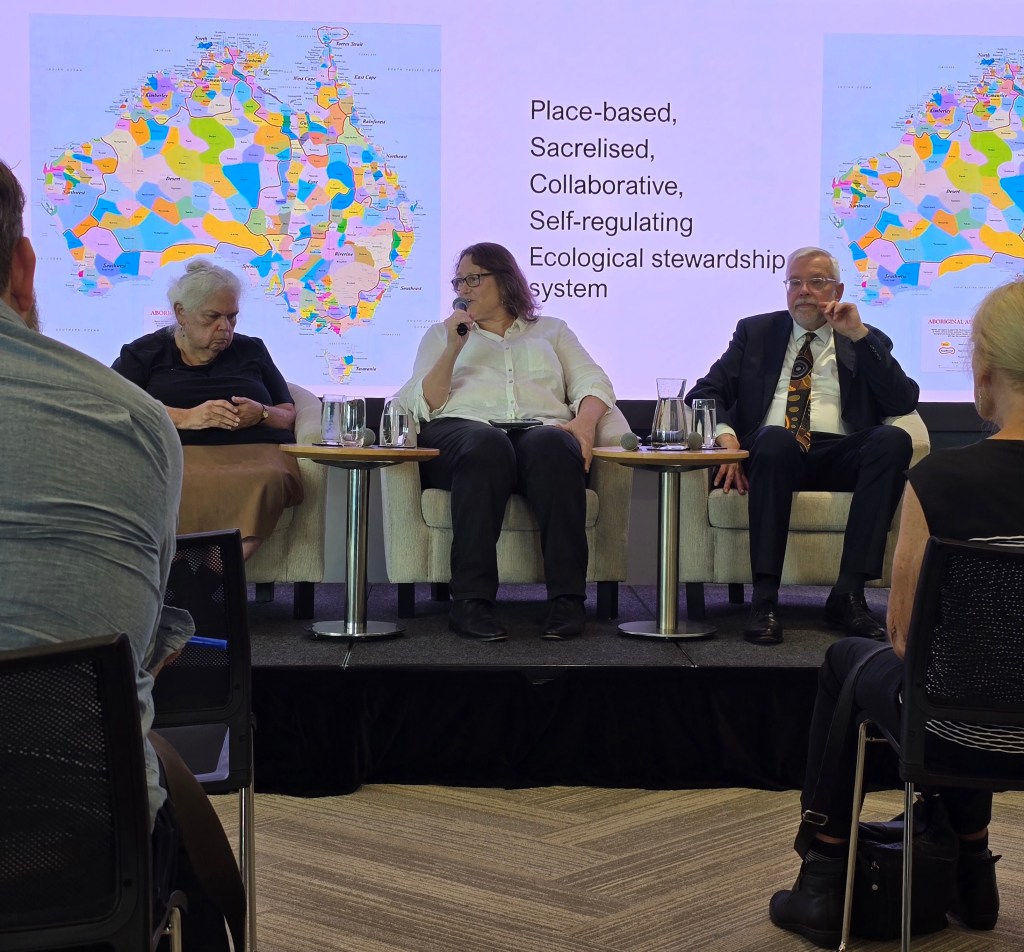
Dr Mary Graham Waijiin Research Centre. The University of Queensland. School of Political Science and International Studies
The Honourable Justice Brian Preston AO – the Chief Judge of the Land and Environment Court in New South Wales.
Dr Michelle Maloney – Australian Earth Laws Alliance – An Earth lawyer and advocate for ecocentric and nature based governance.
First to speak was Dr Maloney citing ‘The Great Work: Our Way Into The Future‘ by Thomas Berry as an important text in helping us understand some of the cracks that exist in our western system. As I haven’t read that book I’ll just leave it at that.
Dr Maloney then invited us to explore the role of rights and obligations in our current system and cited Mabo as a turning point in Australian law after which our legal system became more pluralistic. That is to say after Mabo, the state was no longer the only voice in the legal landscape. An example of a pluralistic legal framework is one where formal (statutory) laws coexist with community or religious norms, indigenous traditions or international regulations. Moving on, Dr Maloney mentioned a future evolution of the legal system towards one that is orientated around Bioregions. This alignment could make it easier to recognise and ultimately protect the ecological relationality of a place. This may, I’m guessing, make it more difficult for off-set schemes to continue to justify disturbing one place by planting a few trees somewhere (anywhere) else.
Next up with Justice Preston who gave us a very thorough presentation outlining how legal rights, obligation and powers currently work and how our legal system, in being aligned with a philosophy of ‘economic growth at any cost’ is incompatible with protecting the planet. He mentioned that our laws are not currently protecting biodiversity. Posed the question ‘can our system meet needs that we don’t yet understand?” and then talked us through a potential solution – If we focus on our obligations there would be no need to worry about understanding the needs as our obligations would have them covered. That our Environmentally responsible duties could be covered if we develop law from the environment rather than just applying laws to it.
Dr Mary Graham was the last to present, giving a passionate talk on how ‘this land grew us up. we became human here’. Dr Graham emphasised that the land belongs to its self – there is no other god, emphasised that in Aboriginal cultures the power always stays with the people.
Dr Graham has produced some very interesting work on Aboriginal philosophy. Here are some snippets that immediately resonated with me:
Autonomy: The power always stays with the people. Autonomy as a relational-social capacity. Autonomy requires others (Aboriginal political thought)
The relationalist ethos can be simply described as abiding attentiveness and responsibility to the patterns, contingencies, and ethical obligations that arise with relations. The relationalist ethos is a foundational Aboriginal philosophy emphasizing that all beings and land are deeply interconnected through kinship and reciprocal obligations
The Law of Obligation is a non-transactional ethic of stewardship and reciprocity. People caring for land caring for people.
On Liberalism: Liberalism constructs a moral world but it is unmoored from place. Liberalism doesn’t have a time except for future.
On Rene Descartes: I think therefore I am translated into Aboriginal speak ‘I am (located) therefore I am’. World view
On Colonisation: Colonisation is an example of the survivalist ethos. Don’t ideologize conflict – thinking of the other as horrible people.
Custodial ethic: The ethic of looking after, looking after is embedded in everything we do.
On Working with Others: All perspectives are valid and reasonable but not necessarily true.
The event definitely gave me a lot to think about both on a personal and professional (Landcare) level. I’d definitely recommend checking out the work of Earth Laws Alliance to anyone interested in making lasting a lasting difference in the landscapes on which we live, love and work. It’s all very interesting.
Additional Links.
Stability, security and survival: a conversation with Mary Graham on ABC radio.
The law of obligation. aboriginal ethics: australia becoming, australia dreaming. 2023.
Can Aboriginal Political Philosophy and political liberalism be reconciled? ABC radio’s ‘The Minefield’ podcast. 11 November, 2020.


