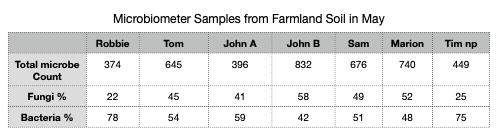
Every year Central Tablelands Landcare & Land Services runs a month-long festival of fungi called ‘Mycology May’. Our last event of the season was an intimate farmer-focused session with compost expert and soil microbiology enthusiast Dr Ernie Harbott from Compost Culture in Singleton, NSW. During the session we tested our soil samples two ways. First we used the Microbiometer – a device that produces a snapshot of your soils microbial activity and in particular it’s fungi:bacteria balance (or ratio).
Here are our Microbiometer results:
The we compared microbiometer results with what we saw under the microscope, the highlights of which are in the film below:
Here’s a helpful microbe-id chart for those of you that want to play along!
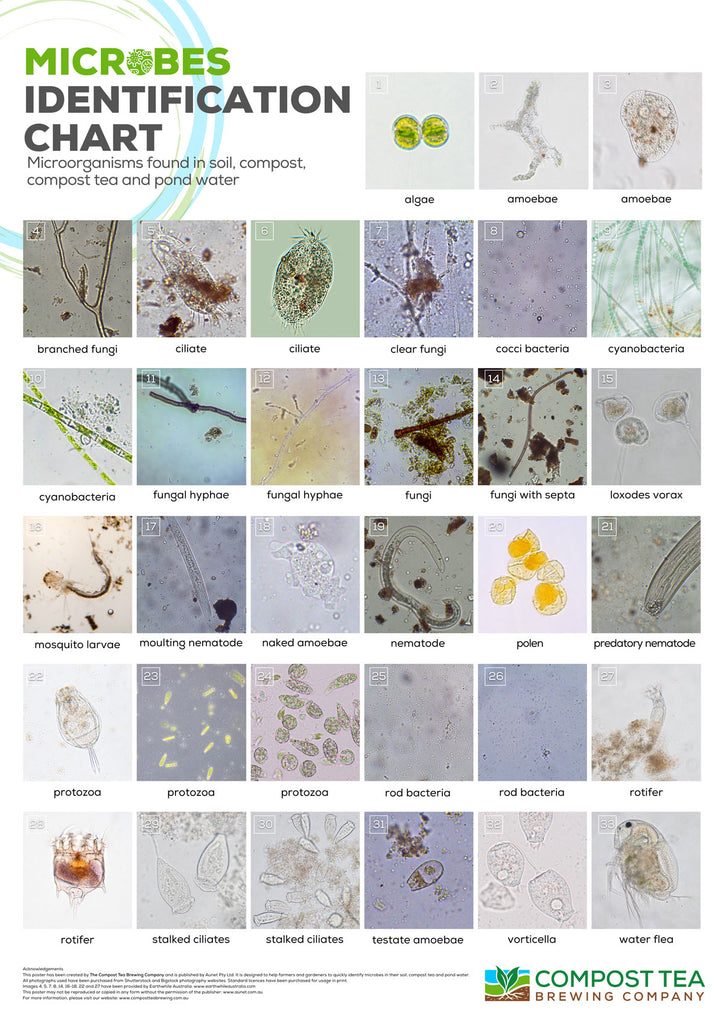
Turns out while hunting for critters under a microscope is lots of fun it’s also very time consuming and requires a decent level of prior knowledge. For those reasons , on the day we concluded it would be unlikely that many farmers would add microscopic analysis of soils as part of their regular routine. However, we did all agree, it’s greatly motivating and very interesting to see the life in our soils from time to time – especially at those times when a management decision has to be made.
Follow-Up Research
After the event, I read more about soil microbes. I wanted to know if scientists agree on a single ‘signature’ microbe that proves soil is healthy. Turns out that there is – the humble Testate Amoeba. I was pretty happy about that as we did find these in some of our samples AND they are quite easy to spot, dead or alive!
Here’s one of the papers I found helpful in answering my question. It’s particularly valuable as it’s a literature review rather than a stand-alone paper.
Testate Amoebas look a bit like the ghosts in the pac-man games (yes, showing my age). They come in a few different sizes, colours and mouth part shapes, all of which can be used to more precisely identify them. The Testate part of their name refers to the fact they have a shell. That shell persists in the soil even after the organism dies meaning no matter how old or dry your soil sample, the signature of these critters will still be there and, more importantly can still be picked up under the microscope.
Maybe soil microscopy isn’t so hard after all…
I continued researching in order to learn more about the different ways searching for testate amoebas in soil had been applied.
Testate amoebae are informative bioindicators of critically high ammonia deposition on peatlands.
Can Soil Testate Amoeba Be Used To Estimate Time Since Death?
Soil Microbes and Carbon Sequestration
I found a number of articles talking about this and found the relationship between plant species and carbon sequestration potential extremely interesting and potentially valuable for our farmers.
Microbial Solutions to Soil Carbon Sequestration.
How Soil Microbes Vary Between Grasses and Forbes
Root exudate composition of grass and forb species in natural grasslands.
We all really enjoyed our time with Dr Ernie from Compost Culture and would thoroughly recommend inviting her to your next soil microbiology/ compost/ soil health workshop.


 Mid Lachlan Landcare